When a Seed Wakes Up: From Visible Change to Biological Mechanism
When a Seed Wakes Up: From Visible Change to Biological Mechanism
How Germination Really Works
MIDDLE SCHOOL Grades 6-8 (Ages 11-14) | From Observation to Mechanism
Other Ways of Ordering: Seed Gallery Academic Posters | All-in-One Seed Academic Ebook =======================================================
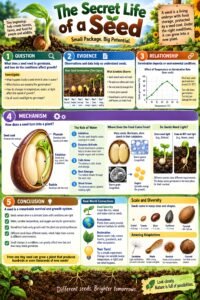
The visible transformation of a seed becomes a biological system. Students investigate imbibition, metabolism, stored reserves, respiration, environmental variables, root and shoot development, and differences among seeds. Introductory experimental thinking connects observations with measurable evidence.
Learning focus: Mechanism • Variables • Evidence • Relationships
=======================================================
By middle school, “a seed needs water to grow” is no longer enough.
Students are ready to ask what the water actually does.
That shift from description toward mechanism is central to the downloadable and printable Middle School Seed Academic Edition Infographic Poster level of Learning or Academic Edition Gallery.
Seed germination provides an excellent introduction to biological systems because visible changes can be connected directly to processes occurring inside cells and tissues.
Consider a dry viable seed.
Its metabolism may be greatly reduced, yet its living tissues retain the capacity to resume development when environmental and internal conditions permit.
Water uptake begins through imbibition, a physical process in which dry seed materials take up water. Hydration changes the physical state of tissues and supports the resumption of metabolic activity.
Enzymes participate in mobilizing stored reserves. Depending on the seed, those reserves can include carbohydrates, lipids, and proteins.
Cellular respiration helps convert energy stored in organic molecules into forms cells can use for growth and maintenance.
This explains why oxygen matters.
The developing embryo requires energy, and aerobic respiration depends on oxygen. Excessively waterlogged conditions can therefore create problems for many terrestrial seeds because water occupying soil pore spaces can reduce oxygen availability.
Temperature matters as well.
Biochemical processes are temperature-sensitive, but there is no single ideal germination temperature for every species. Each species has environmental ranges shaped by its biology and ecology.
Then the visible developmental sequence begins.
The radicle generally emerges first and develops into the root system. Root growth helps anchor the seedling and increases access to water and mineral nutrients. The shoot develops in another direction, eventually positioning photosynthetic tissues where they can capture light.
Students can now begin discussing plant responses such as gravitropism and phototropism while recognizing that these developmental responses involve regulated growth rather than conscious behavior.
The Middle School Seed Academic Edition Infographic Poster also introduces variables.
Suppose students investigate temperature and germination.
What is the independent variable?
What is measured as the dependent variable?
Which conditions should be controlled?
Would “number germinated” and “time to germination” answer exactly the same question?
What sample size would provide more useful evidence than observing a single seed?
These questions transform germination into experimental science.
Students can graph cumulative germination, calculate percentages, compare groups, and discuss variability.
They also encounter uncertainty.
Two seeds of the same species grown under apparently identical conditions may not germinate at exactly the same time. Biological systems vary. Seed age, viability, genetics, previous storage conditions, dormancy status, and small environmental differences can influence outcomes.
That makes germination a powerful model for teaching that scientific evidence often involves patterns rather than perfect uniformity.
The poster’s purpose is therefore not simply to provide more terminology than an elementary version. It is to reveal relationships:
environment → physiological response → metabolism → development → observable outcome.
This makes the downloadable and printable Middle School Seed Academic Edition Infographic Poster appropriate for science classrooms, homeschool curricula, STEM spaces, gardening programs, laboratories, and student study areas.
It can stand alone or bridge younger visual explanations with the more quantitative high-school editions.
Order the Middle School Seed Academic Edition Infographic Poster individually, or explore the complete Learning or Academic Edition Gallery and choose whichever levels best fit your learners. Give posters away to classrooms, science clubs, community gardens, or homeschool groups, or gift them to students, teachers, young gardeners, and future biologists. Or, find out more about the other dimensions of learning “The Secret Life of a Seed” in the Seven Complementary Educational Dimensions.
A germinating seed is more than a life-cycle stage.
It is a working biological system and an invitation to investigate how living things respond to their environment.


Pingback: The Secret Life of a Seed – Learning or Academic Dimension