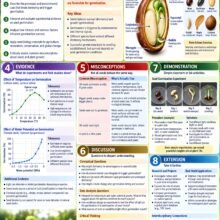
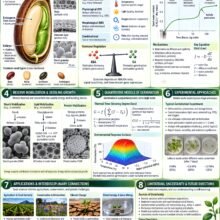
The Waking Seed as a Research System: Evidence, Models and Unanswered Questions
The Waking Seed as a Research System: Evidence, Models and Unanswered Questions
Seed Germination: From Established Knowledge to Open Questions
Academic Scholar (Ages 25+) | Research-Oriented Reference
Other Ways of Ordering: Seed Gallery Academic Posters | All-in-One Seed Academic Ebook =======================================================
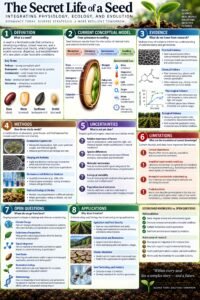
The collection culminates in a research-focused synthesis of germination as an active scientific field. Established mechanisms are distinguished from models and unresolved questions while examining dormancy, environmental sensing, hormonal networks, metabolism, quantitative modeling, experimental methodology, uncertainty, ecological relevance, and emerging research directions.
Learning focus: Evidence • Models • Limitations • Uncertainty • Research
=======================================================
A familiar biological phenomenon can become scientifically unfamiliar when examined closely enough.
Seed germination is an excellent example.
The Research / Scholar Version of “The Secret Life of a Seed — What Happens When a Seed Wakes Up?” treats germination not as a finished textbook story but as an active domain of investigation.
Its structure follows:
definition → current conceptual model → evidence → methods → uncertainties → limitations → open questions → applications.
At its simplest, germination describes the sequence of events beginning with water uptake by a viable seed and culminating, under a commonly used physiological definition, in protrusion of the radicle through surrounding structures.
Even this definition requires qualification.
Researchers studying seed testing, ecological establishment, crop emergence, or normal seedling development may use different operational endpoints.
Definitions shape measurements.
Current conceptual models integrate environmental sensing, dormancy state, hormonal regulation, metabolic reactivation, reserve mobilization, cellular repair, growth potential, and the mechanical resistance of surrounding tissues.
ABA and GA occupy prominent positions in many regulatory models, but seed behavior emerges from interacting networks rather than from a simple binary hormonal switch.
Environmental signals—including temperature, water availability, oxygen, light, nitrate, seasonal history, and disturbance-related cues—can influence these networks in species-specific ways.
Evidence comes from multiple methodological traditions.
Controlled germination assays quantify population responses.
Mutant and transgenic approaches can investigate gene function.
Transcriptomic, proteomic, metabolomic, and hormonal analyses characterize molecular changes.
Imaging can reveal structural and developmental processes.
Biomechanical approaches examine tissue resistance and embryo growth potential.
Ecological experiments test whether mechanisms inferred under controlled conditions predict emergence and establishment under realistic environmental variability.
Each method has strengths and limitations.
Laboratory control improves causal isolation but can reduce ecological realism.
Molecular association does not automatically establish organism-level causation.
Field studies capture complexity but can make mechanisms difficult to isolate.
Population-level germination curves can conceal substantial individual heterogeneity.
Quantitative models—including thermal-time, hydrotime, and hydrothermal approaches—can summarize environmental responses and generate predictions.
Their parameters, however, are conditional on assumptions, species, populations, physiological state, and experimental range.
Extrapolation beyond those boundaries requires caution.
Important uncertainties remain.
How should models integrate fluctuating rather than constant environments?
How stable are parameter estimates across seed lots and maternal environments?
How do epigenetic states contribute to dormancy and environmental memory?
How do microbial interactions alter germination outcomes?
How will altered temperature and precipitation regimes reshape dormancy cycling, emergence timing, and recruitment?
How effectively can mechanistic knowledge scale from controlled experiments to heterogeneous natural landscapes?
These questions matter far beyond basic botany.
Seed germination research influences crop production, restoration ecology, weed science, conservation, seed banking, biodiversity management, invasive-species research, and predictions of vegetation responses to environmental change.
The research edition therefore deliberately distinguishes established knowledge, working models, assumptions, methodological constraints, interpretation, and unresolved questions.
It does not present scientific knowledge as static.
Instead, it visualizes science as a process of increasingly constrained explanation.
That makes this version especially appropriate for advanced students, researchers, laboratories, university departments, botanical institutions, science libraries, and anyone who values research-oriented visual synthesis.
It can also serve as the culminating poster in the entire Learning or Academic Dimension Gallery: the point at which a simple childhood question, “What happens when a seed wakes up?” becomes a network of research questions without final answers.
Order the Academic / Research / Scholar Level individually, choose whichever level in the gallery most interests you, or collect the complete academic progression. Give editions away to laboratories, departments, educators, or science organizations, or gift them to researchers, graduate students, professors, botanists, ecologists, agronomists, and serious plant enthusiasts. Or for further learning, find out more about the other dimensions of learning “The Secret Life of a Seed”.
The deeper science goes, the more interesting the original question becomes.
A seed wakes.
We can describe it.
We can measure it.
We can model it.
And we are still discovering exactly how it works.