From Seed to Sprout: Building the First Scientific Explanation
From Seed to Sprout: Building the First Scientific Explanation
From Seed to Sprout
EARLY ELEMENTARY K–2 (Ages 5-8) | Building Scientific Vocabulary Poster Version
Other Ways of Ordering: Seed Gallery Academic Posters | All-in-One Seed Academic Ebook =======================================================
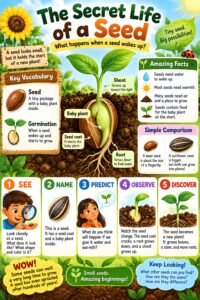
Young learners move from simply observing germination to beginning to explain it. Clear diagrams introduce essential vocabulary such as seed coat, embryo, root, shoot, and germination, while showing how water and suitable environmental conditions help development begin.
Learning focus: Identify • Sequence • Explain • Predict
=======================================================
Children between approximately five and seven years old are ready to move beyond simply watching a seed change.
They can begin explaining why some of those changes happen.
The EARLY ELEMENTARY K–2 Seed Academic Edition Infographic Poster level of Learning or Academic Edition Gallery builds that bridge by combining clear visual storytelling with a carefully selected layer of scientific vocabulary.
The journey begins with the seed itself.
Inside is a developing plant called an embryo. The seed also contains or has access to stored food reserves that support early development. Around the outside is a protective seed coat.
When suitable conditions occur, germination can begin.
Water is central to this transition. The seed absorbs water and swells. Internal metabolic activity increases, and the growing embryo begins using stored resources.
Eventually, the seed coat is breached and the embryonic root emerges.
That first root is called the radicle.
For young students, this is a powerful vocabulary word because it corresponds to something they can actually see. Instead of memorizing an abstract definition, learners can point directly to the structure in a germinating seed illustration.
The developing shoot follows. As the seedling becomes established, leaves expand and the young plant increasingly acquires the ability to capture light for photosynthesis.
This creates an understandable sequence:
dry seed → water uptake → seed opens → root emerges → shoot emerges → leaves develop.
Yet the K–2 edition can introduce something equally important: plants do not grow because they have been given a magical list of ingredients.
Environmental conditions influence biological processes.
Seeds generally require water and oxygen for successful germination, while appropriate temperature ranges vary among species. Some seeds respond to light or darkness; others require special environmental cues or dormancy-breaking conditions.
That qualification prevents a simple introductory lesson from becoming a misconception later.
The poster also creates opportunities for prediction.
Show children a dry seed and a germinating seed.
What differences can they identify?
Ask what they expect to appear first.
Place suitable seeds under contrasting classroom conditions when safe and appropriate.
What could be observed?
Which conditions should remain the same if students want to compare one variable fairly?
Even before formal instruction in experimental design, children can begin learning that scientific questions are answered through careful comparisons.
The K–2 poster can therefore support reading, science vocabulary, sequencing, observation, drawing, discussion, and introductory investigation simultaneously.
It is especially useful in classrooms because learners can repeatedly consult the visual sequence while explaining the process in their own words.
Teachers might cover the labels and ask students to identify structures. Parents might use the poster while planting a garden. Homeschool learners might photograph or sketch a germinating seed and compare it with the infographic.
The subject becomes memorable because the learner can connect a diagram with something real.
This downloadable and printable Early Elementary Seed Academic Edition Infographic Poster also sits naturally within the larger Learning or Academic Edition Gallery. Students can begin here and later encounter middle-school physiology, high-school mechanisms, quantitative models, university-level evidence, and research questions.
The scientific phenomenon remains recognizable even as the explanation becomes deeper.
Order the Early Elementary Seed Academic Edition Infographic Poster individually for a classroom, homeschool space, library, science corner, or child’s room, or collect the entire Learning or Academic Edition Gallery to follow seed science across academic levels. Give individual posters away to teachers and learning programs, or gift one to a young gardener, budding biologist, student, parent, or science-loving family. Or, you can find out more about the other dimensions of learning “The Secret Life of a Seed” in the Seven Complementary Educational Dimension.
A child who learns to look carefully at a germinating seed is learning more than plant science.
They are learning that ordinary things can contain extraordinary processes—and that careful observation can reveal them.

Pingback: The Secret Life of a Seed – Learning or Academic Dimension