Seed Germination as a Model Biological System
Seed Germination as a Model Biological System
Seed Germination as a Model Biological System
University Introductory (Ages 18-20) | Introductory Biology & Plant Science
Other Ways of Ordering: Seed Gallery Academic Posters | All-in-One Seed Academic Ebook =======================================================
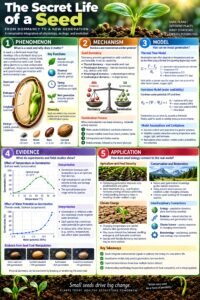
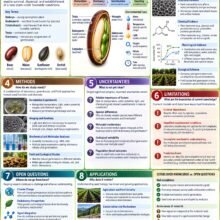
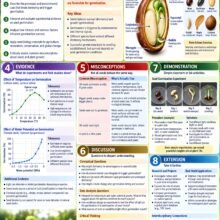
Seed germination becomes a model for understanding how biological systems integrate environmental signals with physiology. The infographic connects water uptake, metabolism, respiration, hormonal signaling, temperature response, dormancy, experimental evidence, and ecological or agricultural applications.
Learning focus: Phenomenon • Mechanism • Model • Evidence • Application
=======================================================
A seed offers an unusually elegant way to introduce university students to the logic of biological science.
The phenomenon is familiar.
The underlying mechanisms are not.
The Undergraduate General-Education / Introductory Version of “The Secret Life of a Seed — What Happens When a Seed Wakes Up?” organizes the subject through:
phenomenon → mechanism → model → evidence → application.
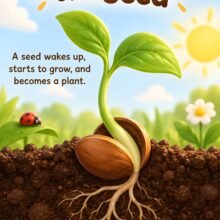
The phenomenon begins with the transition from a relatively dry, metabolically reduced state toward active development.
Following sufficient water uptake, membranes and macromolecular systems become rehydrated, metabolism intensifies, stored reserves are mobilized, cellular respiration supports energetic demands, and embryonic tissues resume growth.
The completion of germination is commonly operationally defined by emergence of the radicle through surrounding structures, although precise definitions can depend on research context.
That operational definition matters.
Science requires measurable criteria.
Mechanistically, germination reflects interactions among the seed’s developmental state, environmental conditions, metabolic capacity, and regulatory signaling.
Plant hormones play important roles. Abscisic acid is strongly associated with dormancy maintenance in many contexts, whereas gibberellins can promote processes favoring germination. Yet hormonal control operates through interacting networks rather than a universal two-switch system.
Temperature introduces quantitative thinking.
A simplified model may describe germination as occurring between species-specific base and ceiling temperatures, with an optimum or favorable range between them. Thermal-time models can sometimes approximate developmental timing over limited temperature ranges.
A general thermal-time expression may be represented conceptually as:
θ = Σ(T − Tᵦ)Δt
where θ represents accumulated thermal time, T is temperature during an interval, Tᵦ is a base temperature, and Δt represents the duration of that interval.
Such a model can be useful—but it is an idealization.
Responses can become nonlinear near physiological limits. Seeds within a population vary. Dormancy status may change. Water potential can interact with temperature. Field temperatures fluctuate.
University learners should therefore distinguish model usefulness from literal biological reality.
Evidence can come from controlled germination assays, physiological measurements, biochemical analysis, molecular studies, ecological field observations, and comparative research across species.
Each method answers different questions.
A controlled laboratory assay can isolate variables effectively but may sacrifice ecological realism. Field experiments provide environmental relevance but introduce additional uncontrolled variation. Molecular measurements may identify regulatory changes without demonstrating that a single molecular factor is sufficient to explain the whole-organism response.
This distinction between observation and interpretation is fundamental.
Applications extend from crop establishment and horticulture to weed management, ecological restoration, conservation, seed banking, climate-response research, and invasive-species biology.
Agricultural scientists may want rapid, synchronized germination.
Conservation biologists may instead need to preserve dormancy until suitable environmental conditions occur.
The same biological process can therefore have different practical implications depending on the system and objective.
This University Introductory Seed Academic Edition Infographic Poster is designed for general biology, environmental science, plant science, agriculture, introductory ecology, science literacy courses, and interdisciplinary programs.
It encourages students to move beyond “what seeds need” and toward the more sophisticated question of how researchers construct and test explanations.
Order the Undergraduate Introductory Poster individually, select whichever academic levels interest you, or build the complete Learning or Academic Edition Gallery. Give editions away to university classrooms, laboratories, libraries, teaching assistants, or student organizations, or gift them to undergraduates, educators, gardeners, and emerging scientists. And for further learning, find out more about the other dimensions of learning “The Secret Life of a Seed”.
A seed is a small biological system.
Studying it carefully reveals something much larger: how science turns phenomena into mechanisms, models, evidence, and useful knowledge.