Inside the Seed: Discovering the Machinery of a New Plant
Inside the Seed: Discovering the Machinery of a New Plant
Inside the Secret Life of a Seed
ELEMENTARY MASTER Grades 3–5 (Ages 8-11) | The Complete Elementary Foundation
Other Ways of Ordering: Seed Gallery Academic Posters | All-in-One Seed Academic Ebook =======================================================
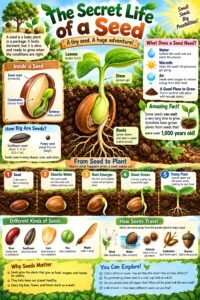
A richer visual investigation combines seed anatomy with the complete germination sequence. Learners discover the embryo, seed coat, cotyledons, stored food, radicle, plumule, water uptake, respiration, and early seedling development while connecting structures with their functions.
Learning focus: Structure • Function • Process • Environment
=======================================================
A seed is often introduced as the beginning of a plant’s life story.
But scientifically, something even more interesting is happening.
The seed already contains a living developmental system.
The downloadable and printable Elementary Master Seed Academic Edition Infographic Poster level of “Learning or Academic Edition Gallery” opens that system visually, helping learners understand both the structures inside a seed and the sequence of events involved in germination.
A useful starting point is seed anatomy.
The seed coat, or testa, provides protection. Inside is the embryo, containing structures that can develop into the root and shoot systems. Depending on the species, food reserves may be stored largely in cotyledons, endosperm, or both.
Those reserves matter because a newly germinating seed cannot immediately depend on mature photosynthetic leaves.
Germination therefore begins with resources already available within the seed.
Water uptake, called imbibition, rehydrates tissues. Metabolism becomes more active, enzymes participate in mobilizing stored reserves, and respiration supplies usable energy for cellular processes.
Visible changes soon follow.
The seed swells.
The coat may split.
The radicle emerges.
The root system begins developing.
The shoot grows and eventually brings developing leaves into an environment where photosynthesis can increasingly support the seedling.
The sequence is visually dramatic, but elementary learners are also ready to understand relationships among the stages.
Why does the root emerge early?
Why are stored reserves important before leaves are functioning effectively?
Why is oxygen necessary?
Why can unsuitable temperature conditions slow or prevent successful germination?
These questions shift the lesson from what happens to why it happens.
The poster can also correct familiar misconceptions.
Seeds are not simply dead objects that become alive when watered. Viable seeds contain living tissues, although metabolic activity may be greatly reduced in the dry or dormant state.
Plants do not obtain their food from soil in the same sense that animals eat food. Soil can provide water and mineral nutrients, while plants ultimately build organic molecules using photosynthesis once photosynthetic tissues become functional.
And sunlight is not universally required for the germination of every seed. Responses to light differ among species.
These distinctions matter because elementary science is where many lifelong ideas about plants begin forming.
The infographic can support a genuine investigation as well.
Learners might compare germination under different moisture conditions, record the number of seeds germinating over time, measure root length, sketch developmental stages, or discuss how to make a comparison fair.
The result connects anatomy, process, environment, measurement, and scientific reasoning.
Placed in a classroom or homeschool environment, the poster becomes a visual anchor. Learners can return to it during plant experiments, vocabulary review, life-cycle lessons, gardening projects, or discussions about ecosystems.
It also provides a foundation for the more advanced levels in the Learning or Academic Edition Gallery.
Middle-school learners can investigate mechanisms and variables. High-school students can examine cellular respiration and regulation. University students can analyze models, evidence, assumptions, and experimental methods.
The downloadable and printable Elementary Master Seed Academic Edition Infographic Poster is therefore not an isolated resource. It represents one point along a continuum of scientific understanding.
Order the Elementary Master Seed Academic Edition Infographic Poster as a standalone educational poster, or explore the complete Learning or Academic Edition Gallery and choose whichever level best fit your learners. Create a classroom collection, give posters away to schools, libraries, science programs, or homeschool groups, or gift them to students, teachers, gardeners, families, and curious young scientists. Or, find out more about the other dimensions of exploring “The Secret Life of a Seed” in the Seven Complementary Educational Dimensions.
Inside every seed is a biological story.
Learning to read that story begins by looking closely.


Pingback: The Secret Life of a Seed – Learning or Academic Dimension