The First Thanksgiving – Learning or Academic Dimension
The First Thanksgiving – Learning or Academic Dimension
One History. Eleven Levels of Discovery.
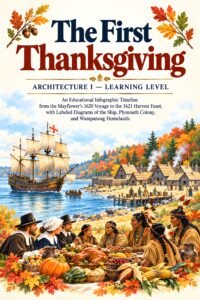
The First Thanksgiving
An Educational Infographic Timeline
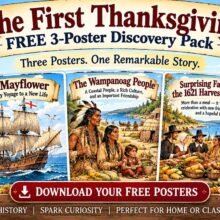
The First Thanksgiving — Architecture I: Learning or Academic Level approaches the same historical subject through eleven carefully differentiated levels of learning, allowing knowledge to grow in depth without losing sight of the people, places, evidence, and uncertainties that make history meaningful.
The journey begins with the Mayflower’s 1620 Atlantic crossing. Learners follow the ship to Cape Cod and Plymouth, examine the difficult first winter, explore the English settlement established at Patuxet, and encounter the Wampanoag people whose homelands extended across what is now southeastern Massachusetts and neighboring areas. The story continues through diplomacy, adaptation, food production, survival, and the autumn 1621 gathering later remembered as the “First Thanksgiving.”
But the collection does not reduce this history to a single cheerful meal.
Instead, it invites learners to discover a more complete story: English colonists arrived in an already inhabited homeland; Patuxet had been a Wampanoag community before epidemic disease devastated its population; relationships between the newcomers and Wampanoag peoples involved diplomacy, mutual interests, cultural exchange, tension, and consequences that unfolded long after 1621.
At the youngest levels, children encounter the subject through recognizable pictures, simple names, observation, and gentle storytelling. Elementary learners progress to timelines, maps, labeled diagrams, foods, people, places, and cause-and-effect relationships. Middle- and high-school levels introduce evidence, interpretation, competing perspectives, historical context, and source evaluation.
Advanced secondary and university versions go further, distinguishing what surviving records directly document from what historians infer. Learners can examine Edward Winslow’s near-contemporary account, William Bradford’s later history, archaeological evidence, Indigenous perspectives, environmental conditions, colonial expansion, and the limitations created by an uneven surviving documentary record.
The Teacher / Professor Edition transforms the subject into an instructional resource with learning objectives, misconceptions, evidence, discussion questions, demonstrations, and extensions. The Academic Scholar / Research Reference Edition reframes the topic as a sophisticated synthesis of sources, methods, uncertainties, interpretations, limitations, and open questions.
Together, the eleven editions demonstrate an important educational principle: the subject can remain the same while the intellectual doorway changes.
A child may begin by asking, “Who was there?”
An older learner may ask, “How do we know?”
A scholar may ask, “Whose evidence survived and how has that shaped the story we inherited?”
That progression is the heart of Architecture I.
Explore the complete Learning or Academic Level Collection, choose the individual level that best matches your learner, classroom, homeschool, library, or study space, or build a coordinated educational gallery across multiple levels.
**Order the complete collection or select individual posters. Display them. Teach with them. Give them away to learners and classrooms—or gift them to a child, parent, teacher, history enthusiast, or lifelong learner.**
A meaningful educational poster can decorate a wall. A thoughtfully designed collection can turn that wall into a place of discovery.