A Tiny Seed Begins to Grow
A Tiny Seed Begins to Grow
Where Wonder Begins
NURSERY LEVEL (Ages 0-3) | First Visual Discovery | Gentle Nature Learning
Other Ways of Ordering: Seed Gallery Academic Posters | All-in-One Seed Academic Ebook =======================================================
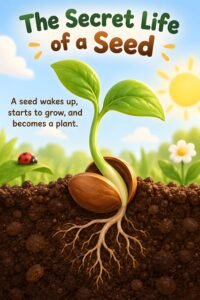
A soft, highly visual introduction to the wonder of seeds and new plant life. Simple seed-to-sprout imagery introduces seed → root → shoot → leaves with minimal text, creating an inviting first encounter with biological growth. Designed primarily for visual recognition, curiosity, and conversation rather than formal instruction.
Learning focus: Notice • Point • Name • Wonder
=======================================================
Before children can read the word seed, they can hold one. Before they understand the science of germination, they can watch a tiny root appear. And long before they are ready for formal lessons, they can begin noticing that the natural world is filled with change.
The Nursery Level edition of “The Secret Life of a Seed – What Happens When a Seed Wakes Up?” is designed for this earliest stage of discovery.
Created for approximately ages 0–3, this educational infographic does not ask very young children to memorize scientific terminology or understand complicated biological processes. Instead, it introduces one beautiful idea through clear, inviting imagery:
A tiny seed can begin to grow.
For babies and toddlers, learning starts with looking, listening, touching, pointing, naming, and repeating. The poster therefore transforms seed germination into a simple visual journey that an adult and child can explore together.
A seed rests quietly.
The seed takes in water when conditions are suitable.
A tiny root begins to emerge.
A shoot grows upward.
Small leaves appear.
A young plant begins its life above the soil.
This progression provides an early encounter with sequence and change. The child does not need to understand every mechanism. At this level, recognizing that one stage becomes another is already meaningful learning.
LOOK • POINT • NAME • WONDER
The Nursery Level edition is designed around these four simple actions.
An adult might point to the first picture and say, “Seed.”
Then to the emerging structure: “Root.”
Then upward: “Sprout.”
Finally: “Leaves.”
These short exchanges connect spoken language with visible objects. Repetition helps familiar words become recognizable, while the illustrations provide meaning before a child can read independently.
The poster can also encourage simple comparisons.
“Where is the seed?”
“Can you find the root?”
“Which plant is taller?”
“Where are the leaves?”
“What changed?”
For the youngest children, even pointing is participation. As language develops, pointing may become naming, naming may become describing, and describing may eventually become questioning.
That is why the Nursery poster is not intended to function as a miniature textbook. Its purpose is to create an inviting first relationship with science.
REAL SCIENCE, GENTLY INTRODUCED
Simple does not have to mean inaccurate.
A seed is not an empty object waiting for life to appear. A viable seed contains living tissues, including a tiny developing plant called an embryo. When conditions are appropriate, germination can begin.
Adults may use words such as “wake up” because they make the transformation easy to imagine, but the phrase is a child-friendly metaphor. Scientifically, the seed is undergoing germination.
Water plays an essential role. As a suitable dry seed takes up water, its tissues become hydrated and biological activity increases. Eventually, the embryonic root can emerge. Later, the developing shoot and leaves become visible.
Not every seed germinates in exactly the same way or under exactly the same conditions. Different plant species have different requirements. Those details belong to later stages of learning.
At Nursery Level, the goal is to preserve the central truth while making it visually understandable:
seed → root → shoot → leaves → young plant
BRING THE POSTER INTO REAL LIFE
The most memorable extension may be just outside the poster.
Let a toddler safely examine a large, age-appropriate seed under close adult supervision, avoiding small items that could present a choking hazard. Look together at a garden bed. Point out a newly emerging sprout. Compare a tiny seedling with a larger plant.
Older toddlers can help an adult water a planted seed and return to observe it over several days.
Nothing needs to become a formal experiment.
The experience can simply be:
Look. Notice. Come back tomorrow. Look again.
That simple routine introduces one of science’s most important habits—careful observation over time.
The poster can therefore become part of a nursery, playroom, preschool transition area, homeschool nature corner, children’s library, family garden space, early-learning center, or quiet reading area. Its role is not to demand attention but to invite it.
THE FIRST STEP IN AN 11-LEVEL JOURNEY
The Nursery edition is also the beginning of the complete Learning or Academic Level Gallery.
The same seed that a toddler first recognizes visually can later be explored through Preschool / Pre-K, Early Elementary K–2, Elementary Master 3–5, Middle School, High School, Advanced High School / AP / IB, University Introductory, University Advanced / Major Level, Teacher / Professor, and Academic Scholar / Research Reference editions.
As the learner grows, the science grows deeper.
WONDER → OBSERVE → NAME → EXPLAIN → INVESTIGATE → ANALYZE → MODEL → EVALUATE → RESEARCH
Yet the original question remains:
What happens when a seed wakes up?
BEGIN WITH ONE SMALL SEED
Order the Nursery Level poster individually as a gentle first introduction to nature and science, or choose the complete 11-poster Learning or Academic Level Gallery to create an educational collection that progresses from a child’s earliest discoveries to advanced scientific understanding.
Display it at home. Add it to a nursery or learning space. Give one away to an early-learning classroom, childcare center, library, nature program, or homeschool family. Gift it to new parents, grandparents, teachers, caregivers, or a young child beginning to discover the natural world.
Because the first science lesson does not need to begin with a textbook.
It can begin with a picture.
A pointing finger.
A curious little voice.
And one tiny seed beginning to grow.
Small Seed. First Wonder. A Lifetime of Discovery.

Pingback: The Secret Life of a Seed – Learning or Academic Dimension