Teaching the Secret Life of a Seed Across Multiple Levels
Teaching the Secret Life of a Seed Across Multiple Levels
Teaching the Secret Life of a Seed
Professional Instructional Reference (Ages 23+)
Other Ways of Ordering: Seed Gallery Academic Posters | All-in-One Seed Academic Ebook =======================================================
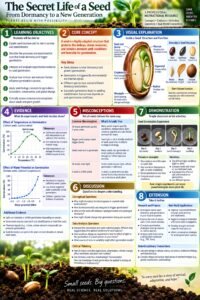
A teaching-centered edition organizes germination around learning objectives, essential concepts, diagrams, evidence, common misconceptions, demonstrations, discussion questions, investigations, and extension opportunities. Designed to help educators adapt the same phenomenon across different learner levels.
Learning focus: Teach • Demonstrate • Question • Assess • Extend
=======================================================
Teaching the Secret Life of a Seed Across Multiple Levels
An effective educational poster does more than contain accurate information.
It helps an instructor teach.
That distinction shapes the Teacher / Professor / Professional Instructional Resource Version of “The Secret Life of a Seed — What Happens When a Seed Wakes Up?”
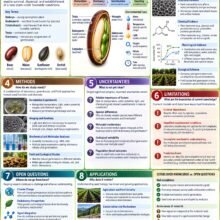
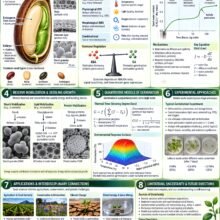
Rather than creating a university poster with more text, this edition organizes the subject pedagogically:
learning objectives → core concept → visual explanation → evidence → misconceptions → discussion → demonstration → extension.
The core concept is deceptively compact.
A viable seed can transition from a relatively inactive state into active development when internal physiological conditions and external environmental conditions permit germination.
From that statement, an instructor can teach at several levels.
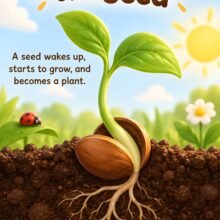
For younger students, the objective may be identifying seed structures and arranging germination stages.
For middle-school learners, the emphasis can shift toward variables, respiration, stored reserves, and environmental responses.
High-school students can investigate hormonal regulation, experimental controls, quantitative data, and limitations.
University learners can evaluate models, methodology, population variability, and competing explanations.
The poster therefore acts as an instructional map rather than merely a summary.
A strong visual cutaway can establish anatomy: seed coat, embryo, cotyledons or other storage tissues, embryonic root, and embryonic shoot.
A developmental sequence then connects anatomy to process.
Water uptake leads into discussion of imbibition and metabolic reactivation. Reserve mobilization creates an opportunity to distinguish stored organic material from mineral nutrients. Radicle emergence connects structure to developmental function. Shoot emergence leads naturally toward photosynthesis and seedling establishment.
Misconceptions deserve explicit treatment.
“Seeds are dead until watered.”
Viable seeds contain living tissues even when metabolic activity is greatly reduced.
“All seeds need light to germinate.”
Light responses vary among species.
“Plants get their food from soil.”
Soil supplies important resources such as water and mineral nutrients, but photosynthetic plants synthesize organic compounds using carbon dioxide, water, and light energy.
“Every seed germinates when conditions are good.”
Dormancy, viability, genetics, environmental history, and other factors complicate that claim.
Discussion questions can deepen instruction:
What evidence would distinguish dormancy from death?
How could students test the effect of one environmental variable while controlling others?
Does faster germination necessarily produce healthier adult plants?
Why might delayed germination sometimes be advantageous?
A demonstration can be as simple as observing suitable seeds over several days, but good pedagogy separates predictions from observations and observations from interpretations.
Students should not be told what their experiment “will prove” before evidence exists.
Extensions can connect seed germination to ecology, agriculture, evolution, climate, statistics, chemistry, plant physiology, and engineering.
That versatility makes the instructional edition useful for lesson planning, classroom discussion, teacher preparation, professional development, laboratory introductions, homeschool instruction, and interdisciplinary teaching.
It can also be displayed beside student-level editions, allowing instructors to see how the same concept can be scaffolded across developmental stages.
Order the professional instructional level for your teaching space, or explore the complete gallery and select the student levels that complement your curriculum. Give posters away to colleagues, schools, libraries, or teacher-training programs, or gift them to educators, professors, homeschool instructors, laboratory demonstrators, and science communicators. And for further information, find out more about the other dimensions of learning.
A seed offers more than a lesson about plants.
Used well, it can teach students how to observe, question, test, interpret, revise—and ultimately understand how scientific knowledge grows.