Germination Beyond the Textbook: Physiology, Regulation and Environmental Response
Germination Beyond the Textbook: Physiology, Regulation and Environmental Response
The Physiology and Regulation of Germination
University Advanced (Ages 20-23) | Plant Biology & Related Majors
Other Ways of Ordering: Seed Gallery Academic Posters | All-in-One Seed Academic Ebook =======================================================
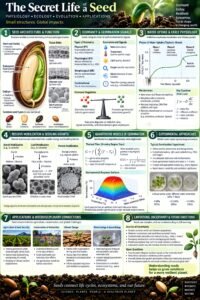
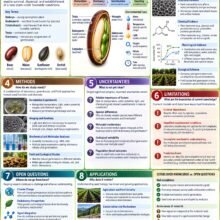
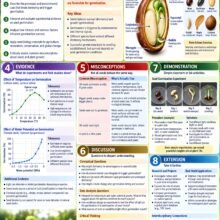
An advanced treatment of seed physiology explores dormancy mechanisms, ABA–GA regulation, reserve mobilization, environmental signaling, thermal and water-potential responses, population variability, experimental methodology, and quantitative germination models. Complexity and boundary conditions remain visible rather than being simplified away.
Learning focus: Regulation • Quantification • Methodology • Uncertainty
=======================================================
For students specializing in plant biology, agriculture, ecology, seed science, or related disciplines, introductory descriptions of germination quickly become insufficient.
“Add water and the seed grows” conceals an intricate physiological transition.
The Discipline-Specialist Version of “The Secret Life of a Seed — What Happens When a Seed Wakes Up?” examines that transition through mechanisms, quantitative models, assumptions, boundary conditions, methodology, uncertainty, and connections to adjacent concepts.
A mature dry seed represents a specialized biological state.
Desiccation-tolerant orthodox seeds can survive substantial water loss, although tolerance varies across species and seed types. Rehydration initiates a complex sequence involving membrane reorganization, metabolic repair, renewed respiration, transcriptional and translational activity, reserve mobilization, and cell expansion.
The process cannot be reduced to hydration alone.
Dormancy status is crucial.
Physiological dormancy may involve regulatory balances that prevent germination even under otherwise favorable conditions. Other species may possess physical dormancy associated with water-impermeable seed or fruit structures, morphological dormancy involving an underdeveloped embryo, or combinations of mechanisms.
Consequently, viability, dormancy, and germinability are not synonymous.
Hormonal regulation adds further complexity.
ABA and GA frequently act antagonistically in germination-related regulatory networks, but responses involve biosynthesis, catabolism, signaling sensitivity, tissue-specific effects, environmental interactions, and gene regulation.
Reserve mobilization also differs among taxa.
Starch-rich endosperm, lipid-rich storage tissues, and protein reserves involve different biochemical pathways. Lipid-rich seeds may rely substantially on β-oxidation and the glyoxylate cycle to convert stored carbon into forms supporting seedling establishment.
Quantitative germination models provide useful abstractions.
Thermal-time, hydrotime, and hydrothermal-time approaches can characterize population responses to temperature and water potential.
Yet parameter estimates depend on model assumptions and experimental conditions.
A fitted model is not a universal physiological law.
Boundary conditions matter.
Temperature responses may deviate from linear approximations near extremes. Water potential thresholds vary among seeds. Dormancy can shift during storage or environmental exposure. Seed populations contain physiological heterogeneity.
Methodology therefore becomes central.
Researchers must consider seed provenance, maternal environment, harvest maturity, storage history, viability, sterilization procedures, substrate, temperature regime, light regime, water potential, replicate structure, scoring criteria, censoring, and statistical treatment.
Even defining “germinated” requires an operational criterion.
Radicle protrusion may be appropriate for one question, while normal seedling development may be necessary for another.
Uncertainty should remain visible.
Observed variation can reflect genetic differences, microenvironmental heterogeneity, measurement error, seed age, maternal effects, dormancy cycling, pathogen exposure, or stochastic biological variation.
Advanced applications connect germination biology to crop establishment, ecological restoration, weed management, conservation, climate adaptation, seed technology, ex situ storage, and predictive ecology.
Climate change adds particularly challenging questions because temperature, precipitation, disturbance, seasonal cues, and species interactions can change simultaneously.
This specialist edition therefore avoids presenting germination as a perfectly ordered universal sequence.
Instead, it presents a regulated developmental transition embedded within evolutionary, physiological, and environmental contexts.
Order the University Advanced Seed Academic Edition Infographic Poster individually for an advanced classroom, laboratory, departmental display, or personal reference collection, or pair it with other posters in the complete gallery to show how scientific explanations increase in depth. Give it away to a laboratory or student group, or gift it to a botanist, agronomist, ecologist, graduate-bound student, researcher, or dedicated plant enthusiast. And for further learning, find out more about the other dimensions of learning “The Secret Life of a Seed”.
The closer we examine a germinating seed, the less simple it becomes.
That complexity is not a problem to eliminate.
It is the science.