From Evidence to Model: Learning to Think Critically About Germination
From Evidence to Model: Learning to Think Critically About Germination
Germination: Evidence, Models & Scientific Reasoning
ADVANCED HIGH SCHOOL / AP / IB Grades 9-12 (Ages 16-18) | Pre-University Investigation
Other Ways of Ordering: Seed Gallery Academic Posters | All-in-One Seed Academic Ebook =======================================================
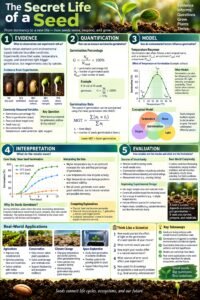
A rigorous transition from textbook biology to scientific analysis. Learners investigate experimental design, independent and dependent variables, controls, germination percentages, rates, biological variability, dormancy, competing explanations, models, and limitations of evidence.
Learning focus: Quantify • Model • Interpret • Evaluate
=======================================================
Advanced Secondary Education occupies an important intellectual space.
Students already know many scientific facts. The next challenge is learning what scientists do with evidence.
The Advanced Secondary Level of “The Secret Life of a Seed — What Happens When a Seed Wakes Up?” therefore moves through:
evidence → quantification → model → interpretation → evaluation.
Begin with evidence.
Suppose multiple groups of seeds are exposed to different environmental conditions. Students might record germination percentage, median germination time, radicle length, respiration-related measurements, or another justified response variable.
Those observations become data.
But data do not interpret themselves.
Students must decide what a measurement represents, whether the experimental design permits a causal inference, and how biological variability affects confidence in the conclusion.
A simple germination percentage can be calculated as:
Germination (%) = germinated seeds ÷ total viable seeds tested × 100
Even this apparently straightforward calculation raises questions.
How was viability determined?
Were seeds lost to contamination?
Were all treatments observed for the same duration?
Does failure to germinate during the experiment prove that a seed is dead?
Not necessarily.
Dormancy complicates interpretation.
A viable dormant seed may fail to germinate even when basic conditions appear favorable. Dormancy can involve physiological, physical, morphological, or combined mechanisms, depending on the species.
Models help organize this complexity.
One conceptual model might describe germination as requiring suitable environmental inputs that interact with the physiological state of the seed. Water availability, temperature, oxygen, light responses, dormancy mechanisms, hormonal regulation, seed maturity, and genotype can all influence the outcome.
But models have boundaries.
A model developed from one species should not automatically be generalized to all flowering plants. Results obtained under constant laboratory temperatures may not predict field performance under fluctuating daily conditions.
This is where evaluation becomes essential.
Students should ask:
Was the sample sufficiently large?
Were seeds randomly assigned?
Were relevant variables controlled?
Were measurements repeated?
How much variation occurred within treatments?
Could an alternative explanation fit the evidence?
Does the graph show correlation, or does the experimental design justify a causal claim?
These questions prepare learners for university science because they shift emphasis from remembering conclusions to evaluating how conclusions are produced.
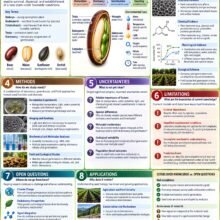
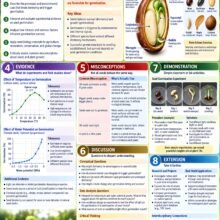
The infographic poster can also introduce competing explanations.
If germination declines in a waterlogged treatment, oxygen limitation may be one hypothesis. But pathogens, tissue damage, or other treatment effects could contribute. A stronger experiment would attempt to distinguish among alternatives.
Likewise, if a treatment changes germination timing, researchers must distinguish effects on dormancy release, germination physiology, viability, or subsequent seedling growth.
Scientific maturity lies partly in resisting explanations that are more certain than the evidence allows.
The Advanced Secondary Level therefore treats the seed as a case study in scientific reasoning.
It is suitable for advanced high school courses, AP/IB-style study, pre-university programs, science enrichment, research preparation, and academically ambitious homeschool curricula.
It also provides a natural transition into the undergraduate level in the larger gallery.
Order this Advanced High School Seed Academic Edition Infographic Poster as a focused advanced-learning resource, or collect several academic levels to create a visible progression from observation to research reasoning. Give posters away to science departments, academic clubs, libraries, or student researchers, or gift one to an aspiring biologist, agricultural scientist, ecologist, teacher, or university-bound learner. And for further learning, find out more about the other dimensions of learning “The Secret Life of a Seed” in the Seven Complementary Educational Dimensions.
The question is no longer simply, “What happens when a seed wakes up?”
It becomes:
“What evidence supports our explanation—and how certain should we be?”

Pingback: The Secret Life of a Seed – Learning or Academic Dimension