Discover the Human Heart’s Amazing Roadmap
Follow the Flow: Discover the Human Heart’s Amazing Roadmap
The Human Heart’s Amazing Roadmap Infographic Posters
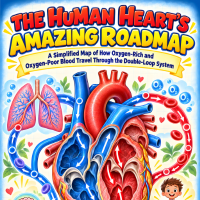
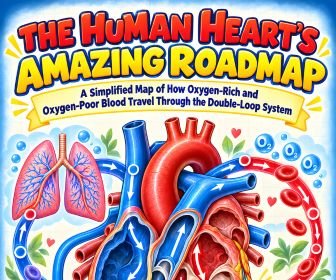
At the center of this educational poster collection is a large cutaway illustration of the human heart. Clearly positioned labels identify the four chambers, four valves, major blood vessels, myocardium, septum, and coronary arteries. Instead of presenting these structures as an intimidating list of terms, the posters connect them through a playful transit-map system. Directional routes reveal where blood enters, which “stations” it passes, and where it travels next.
The pulmonary circuit carries oxygen-poor blood from the right side of the heart to the lungs. There, carbon dioxide leaves the blood and oxygen enters it. Pulmonary veins then return oxygen-rich blood to the left side of the heart. The systemic circuit sends that blood through the aorta to organs and tissues before the venae cavae bring it back. Together, these connected routes form the body’s remarkable double-loop circulation system.
Color makes the journey easier to follow. Crimson identifies oxygen-rich blood, cobalt represents oxygen-poor blood for diagram purposes, and violet marks exchange areas such as capillaries. The posters also clarify an important truth: human blood is always red. Blue is simply a scientific illustration convention.
Different editions make the collection suitable for many ages and settings. Young children can explore bold cartoons, simple sentences, coloring activities, and peaceful nursery art. Older students can investigate cardiac output, valve timing, pressure differences, oxygen transport, and microcirculation. Montessori, vintage-science, minimalist, premium wall-art, blueprint, and myths-versus-facts editions offer distinctive ways to revisit the same essential subject.
The collection works beautifully as a classroom display, science-unit introduction, homeschool resource, study aid, conversation starter, or decorative print. A child may first notice the brilliant colors, while a high school or university student can return to examine increasingly sophisticated details. Teachers can use the route arrows to guide oral explanations, review vocabulary, or invite students to trace a complete drop-of-blood journey.
One memorable calculation makes the heart’s work especially vivid: at 70 beats per minute, it beats 100,800 times in a single day. That is an astonishing amount of activity from an organ roughly the size of a fist.
**Follow every route and discover the wonder inside every beat — view the gallery and purchase your favorite posters for school, office, or home, for your own collection or as an unforgettable educational gift.**